
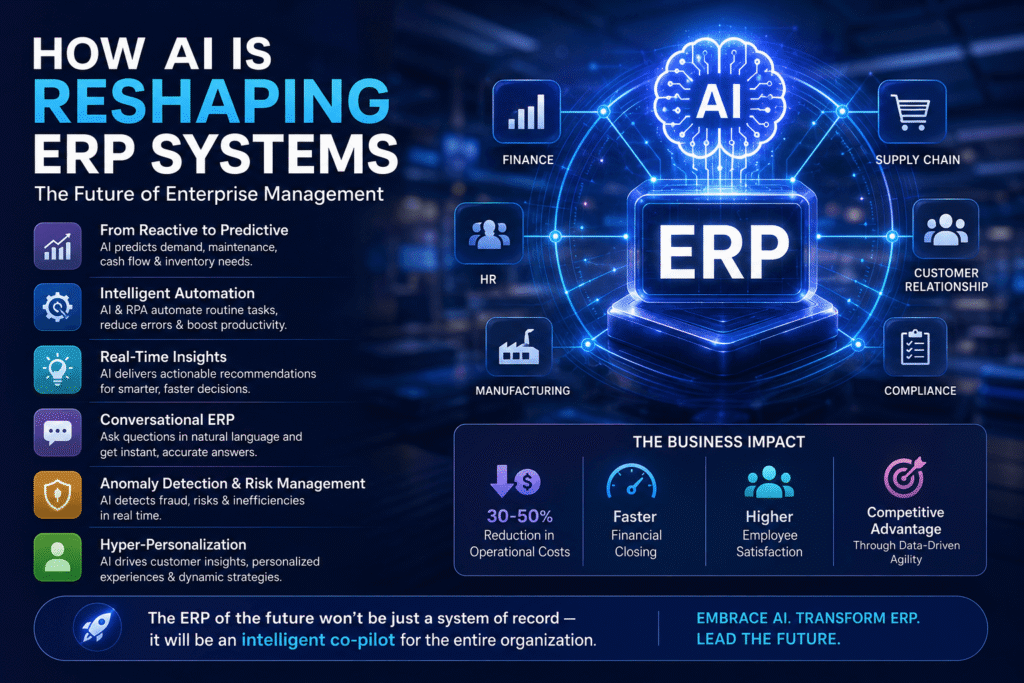
Enterprise Resource Planning (ERP) systems have long been the backbone of business operations — integrating finance, supply chain, HR, manufacturing, and customer data into one unified platform. But traditional ERPs were often rigid, reactive, and heavily dependent on manual input.
AI is changing that forever.
Here’s how AI is fundamentally reshaping ERP systems:
1. From Reactive to Predictive
Modern AI-powered ERPs don’t just record what happened — they predict what will happen.
- Demand forecasting accuracy improves dramatically using machine learning.
- Predictive maintenance anticipates equipment failures before they occur.
- Cash flow and inventory predictions help businesses stay lean and agile.
2. Intelligent Automation
Routine tasks like invoice processing, reconciliation, payroll, and compliance reporting are now handled with minimal human intervention. Robotic Process Automation (RPA) combined with AI reduces errors and frees employees for strategic work.
3. Real-Time Insights & Decision Intelligence
AI analyzes massive datasets in real time and delivers actionable recommendations.
Instead of static dashboards, leaders get natural language insights like:
“Inventory for Product X will face a shortage in 3 weeks due to supplier delays — recommend ordering 15% more from alternative vendors.”
4. Conversational ERP
Natural Language Processing (NLP) and generative AI have introduced chatbots and voice interfaces. Managers can now ask:
“What’s our Q2 gross margin by region?” or “Show me procurement bottlenecks” and get instant answers.
5. Enhanced Anomaly Detection & Risk Management
AI continuously monitors transactions for fraud, compliance violations, or operational inefficiencies — often catching issues humans would miss.
6. Hyper-Personalization & Better Customer Experience
AI helps ERP systems understand customer patterns deeply, enabling dynamic pricing, personalized offerings, and seamless omnichannel experiences.
The Business Impact:
- Up to 30-50% reduction in operational costs (in mature implementations)
- Significantly faster closing cycles
- Higher employee satisfaction (less mundane work)
- Competitive advantage through data-driven agility
Companies like SAP (with Joule), Oracle (with Fusion AI), Microsoft Dynamics 365, and Workday are leading this transformation by embedding AI deeply into their platforms.
The Bottom Line:
The ERP of the future won’t be just a system of record — it will be an intelligent co-pilot for the entire organization.
Businesses still running on legacy ERP systems are essentially operating with a competitive disadvantage in 2026 and beyond.
Are you already implementing AI in your ERP? What has been the biggest change you’ve seen?
AI #ERP #DigitalTransformation #EnterpriseSoftware #FutureOfWork #apcorn #innovation